
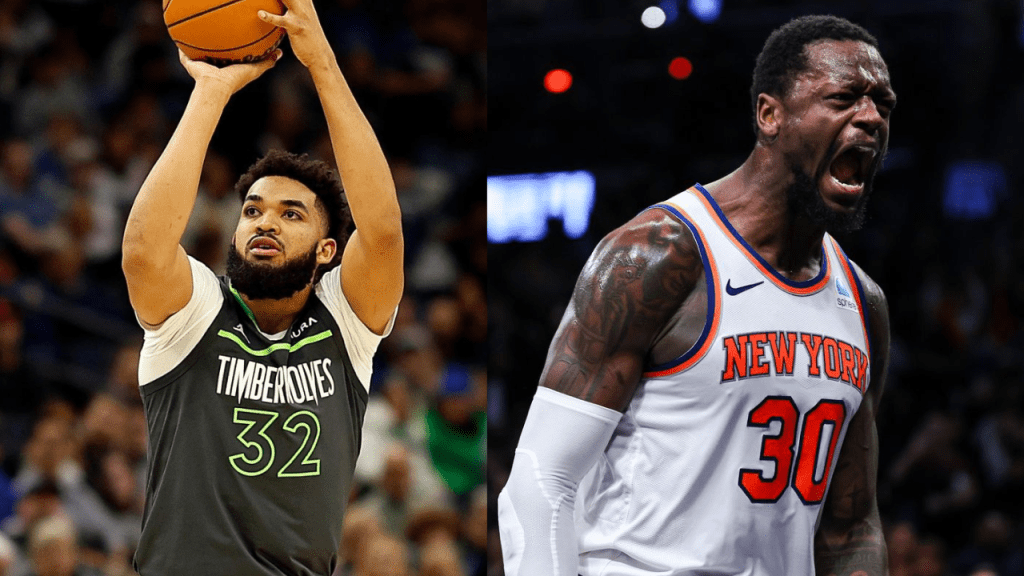
The NBA never fails to surprise us, and the surprises never fail to be exciting. Last Friday night we got our first big trade of the post-Woj era, with Karl-Anthony Towns heading to the New York Knicks in exchange for Julius Randle and Donte DiVincenzo (and former Bench Mob Blog All-Star Keita Bates-Diop). This deal came out of absolutely nowhere, and there is plenty to be said about it. We could talk about the implications for both teams in the standings, who won and who lost, how dirty the Wolves did Towns and how dirty the Knicks did Randle… the list of topics goes on. Today, though, let’s zoom in on just the two stars and take a look at how each one fits in on their new squads.
Karl-Anthony Towns
New York’s center problem has been the talk of the dead part of the offseason, but now the problem has been fully solved as the ‘Bockers are adding one of the best bigs in basketball in the Big KAT. He’ll be able to slide in as the man in the middle and give a massive boost to the Knicks, especially on offense.
With Towns on the floor, coach Thibodeau will have the ability to deploy some super scary five-out schemes. OG Anunoby, Mikal Bridges, Josh Hart/Miles McBride, and the new big fella will form a lethal firing squad that will open up acres of space for Jalen Brunson to cook. Take a look at these shooting numbers from last season:
K. Towns: 41.6% 3P (5.3 3PA)
O. Anunoby: 38.2% 3P (5.3 3PA)
M. Bridges: 37.2% 3P (7.2 3PA)
M. McBride: 41.0% 3P (3.9 3PA)
J. Hart: 31.0% 3P (3.2 3PA)
Who do you leave open? Ideally none of them. In a classic pick-your-poison situation, opposing teams will be forced to choose between trusting their top defenders on an island with Brunson or sending help at the heliocentric Hercules and therefore leaving one of the shooters with enough room to let it fly from deep. Needless to say, both options are less than desirable. Towns is also one of the best pick-and-pop guys in the NBA, which will add a very intriguing wrinkle to Brunson-directed pick-and-rolls. In a league where spacing is a fundamental part of success, the offensive potential of Towns-at-the-five lineups cannot be understated.
Another thing Towns can do from the five spot is replicate some of the passing hub prowess the recently departed Isaiah Hartenstein brought to New York. Towns can make kickouts from the post, thread needles, and even run some pick-and-roll as a ball handler. In fact, he and Rudy Gobert formed a very impactful P&R pairing in Minnesota. An inverse version of basketball’s most popular action between Towns and Jalen Brunson is an intriguing concept, as Brunson popping or ghosting could open up lanes for the big man to barrel downhill and make stuff happen.
Towns is not limited to playing center, though, and in fact it might be the four spot where the former number one pick will be most effective in the Big Apple, specifically for defensive purposes. While he has a big body and can block shots, Towns has never been known for his rim protection. The standard for big man defense when it comes to the playoffs is high, and New York could find a cap on their ceiling with Towns as their primary rim protector. Letting Mitchell Robinson be the anchor down low while Towns operates from the help side and hedges on the perimeter is a better idea and is probably what defensive guru Tom Thibodeau will gravitate towards. On the other side of the ball, Towns would be no less of a spacer as a power forward and could also recreate his jumbo P&R success from Minnesota with Mitchell Robinson. Overall, the Knicks could easily oscillate between running the All-Star at the four and the five and feel good about both options.
The last major thing worth noting about Towns coming to the Knicks is that he is not the same level of playmaker that Julius Randle is. While Jalen Brunson has plenty of off-ball weapons around him now, he no longer has a secondary creator to lean on (unless you trust Mikal Bridges to be that guy). Come playoff time, New York will be leaning so heavily into their superstar and only time will tell if his back will break.
Julius Randle
The masses were immediately critical of Randle’s fit in Minnesota after this trade went down, and to some degree, that was fair. The spot-up shooting and off-ball play that Karl-Anthony Towns provided was essential for the Timberwolves last season, especially when Rudy Gobert, a non-shooting big, was in the game. Julius Randle cannot replicate those things. He’s a career 33% three-point shooter (a streaky one at that) and he does the most damage with the ball in his hands. Unfortunately, the Wolves belong to Anthony Edwards, and he will be controlling the rock. So, how does Randle fit in? There are actually reasons to believe he will fit in well.
As spoken on by Pistons head coach J.B. Bickerstaff on media day, spacing doesn’t only concern three-point proficiency. The three-ball is the most traditional trait of good spacing, but not the only way to achieve it. While Anthony Edwards is attacking in iso, Randle can still be stationed on the perimeter. When he catches the ball, though, rather than shooting, he should have getting to the rim in mind. The two-time All-NBA nominee is an absolute freight train who commands a ton of attention when he puts his head down. By focusing on catching and driving right away, Randle would not only catch defenders out of position but also create advantages for himself and others because he cannot be stopped by just one man. In New York, he generated many shots for his big men by driving to the rim, and he could do the same for Rudy Gobert in Minnesota. Further, his slashing would open up shooters like Anthony Edwards and Mike Conley on the perimeter. Allowing Randle to do what he does best, generating paint touches, in a more controlled capacity is how the Wolves could get the most of him when he’s in the game with the starters.
One way in which Randle will make Minnesota better is by being a creator and taking pressure off Anthony Edwards. The young supernova is one of the best scorers in the league already, but he can’t do everything on his own, and Randle will be able to pick up slack for Ant in a way Towns couldn’t. As touched on, Randle is an elite two-point creator and a very underrated playmaker as well. Don’t forget he led the Knicks to the playoffs on his own in 2021. The modern Knicks legend is very capable of being the number one option on any given night and that will make Chris Finch’s offense more dynamic.
Switching to the other side of the ball, Randle is a more natural fit in the roaming four man role that Towns was asked to play last season. When locked in, which isn’t always, he’s very capable of being a brick wall that slows down opposing bigs and he can also move his feet on the perimeter. The defensive culture that’s been established in the Twin Cities should hopefully be enough to get Randle to buy in full-time on D, and if he does, he could look really solid on that end.
Things seemed clunky on paper initially, and they may still turn out to be that way, but the bottom line is that Julius Randle is an all-league talent and he has plenty to offer to his new squad.
 The Bench Mob Blog
One thought on “How Do Karl-Anthony Towns and Julius Randle Fit on Their New Teams?”