
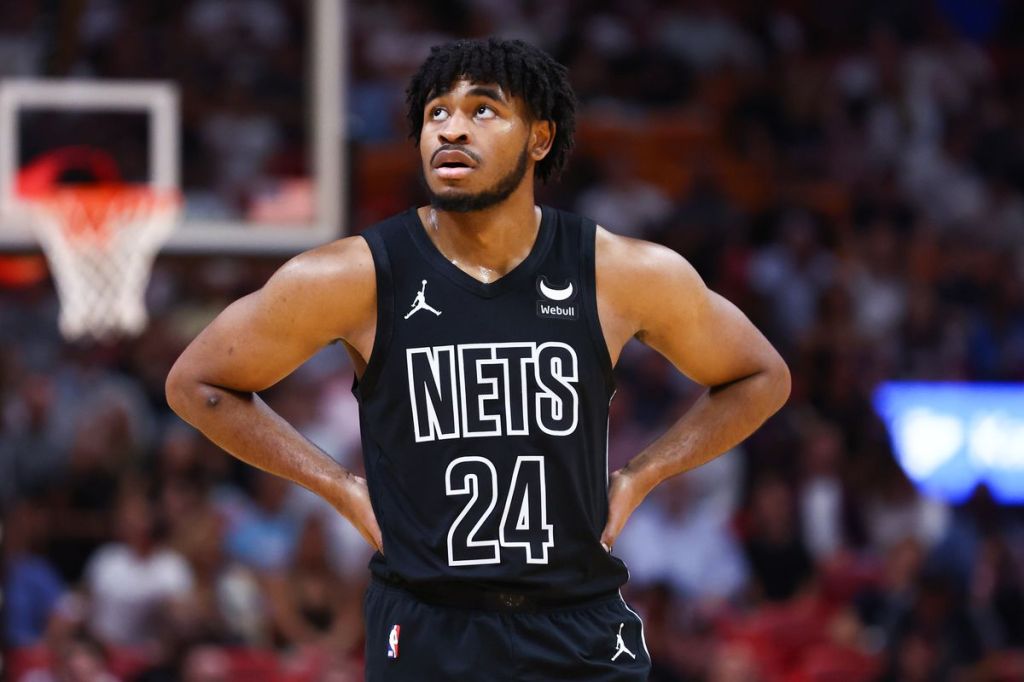
Score-first players face a lot of scrutiny in the NBA world. Teams want players who can affect the game in multiple ways and do the little things like defend and rebound. As a result, the real value of pure microwave bucket getters is uncertain. One guy who is often under the microscope is Cam Thomas of the Brooklyn Nets. Coming off a season in which he averaged a relatively efficient 22.5 points per game and finished seventh in Most Improved Player voting, it’s clear that Thomas is at least a good NBA player. You don’t fill up the scoring column like that on a night-to-night basis by accident. But, how good is Thomas actually? What else does he do besides score?
Thomas’ role is not to defend. He’s a smaller shooting guard with no standout athletic traits. Expecting him to be able to lock up is guaranteed to end in disappointment. However, for a high-usage guard who is often given the freedom to create with the ball in his hands, being unselfish and able to make teammates better is a crucial skill. That’s the trait people want to see from Thomas, because right now he gets lumped into groups of players that never swing the rock. Is giving him that title fair? How good (or bad) of a playmaker is he?
Let’s start with the numbers. Last season, Cam Thomas averaged 2.9 assists per game. That’s the lowest tally out of all 20-point-per-game scorers. He was sixth on the Nets in assists per game, fourth in total assists, and seventh in assist percentage despite ranking 11th in the whole league in usage rate. Clearly, Thomas’ passing output is way less than ideal. He is absolutely all about his buckets, and that’s fine, because scoring is what he’s primarily asked to do. Still, though, he still needs to be able to pass in a pinch. Further, if he ever wants to reach All-Star status, he’ll need to become a respectable playmaker. To find out exactly where he’s at in those categories, let’s dive into the tape.
(Please note that the following numbers are hand-tracked and may be slightly inaccurate due to human error or difference in opinion!)
Out of Thomas’ 189 total assists that were available to watch on thehighlow.io (only three from his overall season total were missing), 69 of them were playmaking assists, with a playmaking assist being categorized as a play where Thomas directly created the advantage for the other player. These assists most commonly came out of the pick-and-roll, where Thomas is an adept director who can draw in help defenders and hit his roll man or an open shooter at the right time. Most of his other playmaking assists came off drives, where the threat of him getting to the rim or pulling up for a middie forced help to step up, subsequently opening up another Net for an easy shot.
Thomas definitely has the capacity to be a playmaker. However, the fact that he dished out just barely over one playmaking assist per game is pretty mind-boggling considering how much he has the ball. Why is that number so low? The man has tunnel vision. He drives 16.1 times per game, a 96th percentile rate, but he only passes the ball out 28.5% of the time, a 39th percentile rate (via BBall Index). Because he’s so hell-bent on shooting, Thomas is prone to dumb turnovers. His handle is underdeveloped for a player of his usage and he coughs the rock up often, sometimes even unforced. His footwork is somewhat suspect and he’ll get called for travels when he tries to pivot. He’ll dribble into bad situations and just throw the ball away. None of those habits are what you want to see from your star player, or any player, for that matter.
It is also worth noting that Thomas received a lot of help from Nic Claxton and Day’Ron Sharpe last season, both of whom are high-quality roll men. Without their screening and lob-catching ability, his assist numbers probably would have looked significantly worse since he doesn’t do too much playmaking out of isolation.
All of that makes Thomas seem pretty bad, but he has some playmaker in him. It will be up to him, and Brooklyn’s coaching staff, to bring that side of him out more often.
Wait, but what about the non-playmaking assists? There were 120 of those miscellaneous assists, and they were more encouraging. Thomas is good at continuing advantages created by others. Brooklyn puts him in a lot of off-ball screen actions, especially zoom, and when flying off of those, Thomas has proved to be a pretty heads-up passer. Perhaps that can be chalked up to set design, but considering his usual ways, that’s still something. Additionally, the LSU product is an unselfish transition player who moves the ball quickly to capitalize on such advantages.
Cam Thomas is far from a well-rounded player. He’s far from an elite playmaker. He’s also just 23 years old and was thrust into a massive role last season for the first time in his career. The young shooting guard has plenty of room to grow, and he’ll have plenty of freedom to spread his wings for the tanking Nets this season. For that reason, along with the flashes he’s shown, there are reasons to feel optimistic about his passing ability. And if he starts swinging the rock, he’ll become one of the most dynamic offensive forces in basketball.
 The Bench Mob Blog